



 READ IN APP

A federal judge late Friday issued a court ruling that put into law what people concerned about our waterways and the explosion of industrial poultry production across eastern Oklahoma’s landscape and nationwide have been saying for decades.
It declares the State of Oklahoma the victor in the case, but does not adopt every recommendation in the State’s proposed ruling. Such proposals are seldom adopted wholesale.
The judge lays out in detail needs such as strict monitoring of waste production and disposal, which have been kept too much of a mystery. He calls for an investigation and planning to assess the status of poultry waste, and to explore restorative options such as buffer strips, drinking water treatment, alum application, bank stabilization, constructed wetlands, and other recovery methods.
Frizzell also places responsibility for the hundreds of thousands of tons of waste produced annually directly on producers, rather than on individual farmers, as has been the case. The ruling requires Tyson, Simmons, and other integrators to bear the cost of waste management and related equipment and facilities, and to hold farmers harmless for associated expenses.
I’ve never understood why this wasn’t already the case, and I would think farmers will appreciate the judge recognizing that unfair arrangement.
This is no trite ruling, and I’ll confess that in reading, I thought these words to myself repeatedly, “as state agencies already should have demanded.”
In a just world, legislators would see this writing from the bench, which they’ve ignored from evidence on the land, and pass rules to get with the program.
I remain hopeful.
Still, I expect that, come Monday, Gov. Kevin Stitt and key legislators will not change their tune. Of late, political gamesmanship has been afoot with a split in the Republican party between Stitt’s faithful and Attorney General Gentner Drummond, who is running to replace the term-limited governor.
All Things Outdoors is a reader-supported publication. To receive new posts and support my work, consider becoming a free or paid subscriber.
They’ve been shouting that Tyson Foods Inc. has no choice but to halt all its contracts in the Illinois River Basin because of the lawsuit. Like frustrated children ready to throw things rather than clean their rooms, they threaten that they have no choice but to cause economic harm to Oklahoma and Arkansas communities and to bankrupt individual farmers they’ve called partners.
We’re going to hear someone say the court is overstepping its bounds. I expect the phrase “legislating from the bench” will be bandied about. Stitt seems to have backpedaled from labelling the judge a radical environmentalist and steered that label towards Drummond, which is laughable.
Tyson backed itself into a corner by threatening the wrong choice before the ruling was issued. Now, they must make a choice and tell us exactly why. The right choice is compliance with the verdict in what should be a landmark case that would influence poultry waste management not just in the Illinois River Watershed, but statewide and nationwide.
But the other thing I think we can expect is an appeal to a higher court.
Tyson and other large poultry, beef, and pork producers seem to have plenty of money for lawyers and settling other class-action lawsuits lately. Still, they threaten to draw a line at taking responsibility for chicken waste.
Here is a list of key findings from my Friday night reading of the 33-page Judgment issued by U.S. Northern District Court Judge Gregory J. Frizzell on the 16th anniversary of months-long hearings at the Tulsa Courthouse and more than 20 years after its filing by then Attorney General Drew Edmondson in June 2005.
KEY TAKEAWAYS
Evidence showed that the poultry companies knew about the damage caused by phosphorus pollution from poultry litter applications since the late 1990s. They are liable for statutory public nuisance, federal common law nuisance, and trespass. They will be fined for 248 documented violations under Environmental Quality Code at 27A Okla. Stat. § 2-6-105. Doc. 2979, COL 52, 60.
They will share accountability for and all the costs of remediation for 30 years.
A special master will be appointed to oversee enforcement of the court ruling and remediation, and will be accountable for regular progress reports to the court. Remediation is to be phased in: first, investigation and planning; then, implementation; and finally, ongoing monitoring.
The master will oversee an appointed Watershed Monitoring Team that will ensure compliance and report regularly to the court. It will collect detailed data on poultry operations, including waste management practices and soil test results.
Costs to the companies include:
The companies must put $10 million into a designated remediation account. If the account balance falls below $5 million, it must be replenished with an additional $5 million.
Tyson Foods, Inc. is fined $160,000.00.
Cobb-Vantress is fined $30,000.00.
Cargill, Inc. is fined $60,000.00.
George’s, Inc. is fined $10,000.00.
Simmons is fined $90,000.00.
Cal-Maine is fined $70,000.00.
Land application of poultry waste is limited to 2 tons or less per acre, with test limits set at a maximum of 120 lbs/acre STP. No litter may be applied on land with an existing STP of 120 lbs/acre or more.
The companies are no longer allowed to pass on costs of waste management to contract growers. Growers are to be provided the necessary equipment and facilities, and held harmless for related expenses.
I don’t know that anyone has said it yet, although I do know he has taken plenty of criticism over the many years this suit lay pending a decision, but Oklahoma has been lucky to have a diligent and thoughtful judge like Frizzell on this case for 20 years.
It outlasted my career in newspapers, that’s for sure.
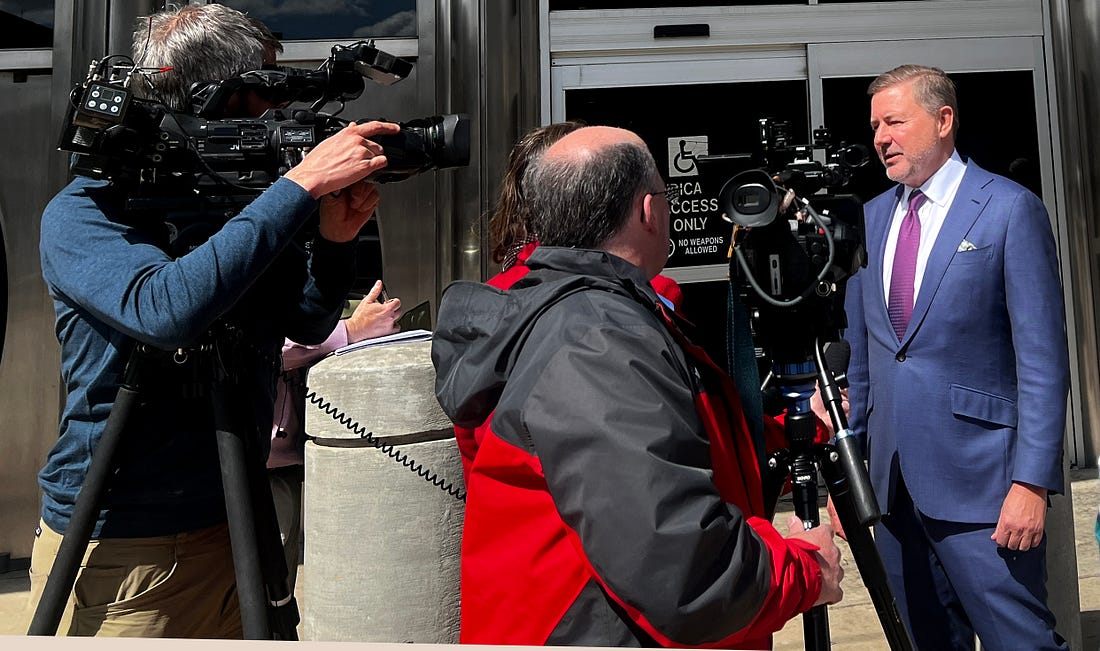
The timing of the suit and assignment to that particular judge at that point in his career to provide this continuity in this massive lawsuit is impressive, I’d say fortuitous. Unmatched, to say the least.
If the companies do appeal, they will face a high bar. Frizzell’s 2023 Findings of Fact and Conclusions of Law is quite a document, not just for the weight of its 219 pages, but for the depth of the findings and countless references.
I’ve reported on landmark Supreme Court decisions in highly complex Alaska Native Subsistence Rights conflicts, and they are light reading by comparison.
Of course, Frizzell’s final ruling references that document repeatedly and rehashes the past two years of court wrangling and failed, some would say refused, mediation that poultry folks recently seem eager to revisit.
Of late, and especially following an eastern Oklahoma shindig with Gov. Stitt and poultry producers last week, industry supporters have been voicing their shared desire for clean water and drive for stewardship, yet label the lawsuit a threat to farming and the economy.
Frizzell addresses public interest, as required, in his ruling, with due respect for the law.
“As for whether the injunction, if issued, will adversely affect the public interest, the court finds and concludes that it will not,” he writes.
“Though defendants call attention to the vested business interests of themselves, their contract growers, cattlemen, and hay farmers in the outcome of this litigation, both they and the public at large have an interest in the enforcement of the environmental claims on which the State has prevailed. The injunction set forth below is consistent with the regulatory scheme that third-party stakeholders are required to follow, as Oklahoma law applicable to this action plainly prohibits pollution of the waters of the State by poultry waste. As for the public at large, its interest is not only in the production of poultry products, but in the responsible disposal of poultry waste in compliance with the law.”
I’d say that about covers it.
LikeCommentRestack© 2025 Kelly J Bostian
8625 E 160th Street S, Bixby, OK 74008
Unsubscribe
